
The decision to hire professional cleaners is rarely about cleaning itself. Beneath the surface of sparkling countertops and vacuumed carpets lies a more profound transformation—one that ripples through your time, relationships, career, and mental wellbeing in ways most people never anticipate when they first make the call.
Most discussions about professional cleaning focus on the obvious: you save hours each week, your home looks better, you avoid the physical strain. These benefits are real, but they represent only the visible tip of a much larger transformation. When you examine the full cascade of changes that professional cleaning triggers, the true value proposition shifts from “paying someone to clean” to “investing in a fundamentally different quality of life.” Services like professional cleaning services don’t just maintain homes—they recalibrate how households function at every level.
This transformation follows a predictable pattern: it begins with the hidden costs you’re currently paying for DIY cleaning, extends through knowledge gaps you don’t know you have, reshapes your household dynamics and self-perception, triggers behavioral changes in unexpected areas, and ultimately compounds into life improvements that extend far beyond anything visible to the eye. The question isn’t whether professional cleaning creates value—it’s whether you can afford to keep ignoring the opportunity cost of handling it yourself.
The Cleaning Transformation in Brief: What Changes Beyond the Surfaces
- DIY cleaning carries invisible costs in decision fatigue, opportunity cost, and fragmented productivity that far exceed the monetary expense of professional services
- Amateur cleaning creates damage risks and misses critical areas due to knowledge gaps in surface chemistry, cross-contamination protocols, and systematic inspection techniques
- Delegating cleaning reshapes family dynamics, particularly gender-based domestic labor distribution, while triggering identity shifts from execution to management
- Professional cleaning acts as a behavioral catalyst, creating environmental cues that trigger positive cascades in organization, social activity, and productivity habits
- The true ROI calculation extends beyond cleaning outcomes to measure second-order impacts on career advancement, relationship quality, health metrics, and overall life satisfaction
The Hidden Tax of DIY Cleaning Nobody Calculates
When you clean your own home, you pay in currency that never appears on a bank statement. The most obvious cost—your time—represents only the beginning of what you’re actually spending. Every hour spent scrubbing bathrooms or mopping floors carries an opportunity cost: what else could you have done with that time, and what is that alternative worth?
If your professional earning potential is $50 per hour, and you spend four hours weekly cleaning, you’re sacrificing $800 monthly in potential income or value creation. But even if you’re not literally working during those hours, the question remains: what could you have built, learned, created, or experienced instead? The opportunity cost calculation forces an uncomfortable truth—for many households, DIY cleaning is the most expensive way to get the job done.
Beyond measurable time lies a more insidious cost: decision fatigue. The average adult makes approximately 35,000 decisions per day according to behavioral research, and each decision depletes your cognitive resources. When you manage your own cleaning, you’re constantly making micro-decisions: when to clean, what to clean first, which products to use, whether you cleaned thoroughly enough, when to restock supplies, and how to organize the work around your schedule.
Decision Conservation in High-Stakes Environments
Barack Obama famously limited his wardrobe choices to conserve decision-making energy for more critical presidential duties. This strategy demonstrates how even mundane choices like what to wear can deplete cognitive resources needed for complex decision-making throughout the day. The same principle applies to household cleaning—every decision about cleaning protocols is mental bandwidth unavailable for more meaningful choices.
This “planning tax” extends beyond the actual cleaning time. You spend cognitive energy thinking about upcoming cleaning sessions, preparing for them mentally, and recovering from the physical and mental exertion afterward. Cleaning interrupts flow states and fragments productivity blocks in ways that make the true time cost far exceed the hours spent with sponge in hand.
| Cost Factor | DIY Cleaning | Professional Service |
|---|---|---|
| Hourly Rate | $0 (unpaid labor) | $17.27 median |
| Equipment Investment | $500-1000 initial | Included |
| Supply Costs | $30-50/month | Included |
| Training Time | Self-taught | Professional expertise |
The comparison becomes even starker when you account for the mental load—the invisible labor of remembering, planning, and managing household tasks that often falls disproportionately on one household member. This cognitive burden creates stress that compounds over time, affecting sleep quality, emotional regulation, and overall wellbeing in ways that never appear in simple time-savings calculations.
Signs you’re experiencing cleaning decision fatigue
- Struggling to make even small decisions about when or what to clean
- Feeling emotionally drained after planning cleaning schedules
- Experiencing decision paralysis when choosing cleaning products
- Mental and physical tension from managing household tasks
- Procrastinating on cleaning due to overwhelming choices
When Professional Standards Expose Your Cleaning Blind Spots
Most people dramatically overestimate their cleaning effectiveness—a classic manifestation of the Dunning-Kruger effect applied to household tasks. You know how to make surfaces look clean, but professional cleaners possess specialized knowledge about surface chemistry, cross-contamination protocols, and damage prevention that most homeowners have never even considered.
The expertise gap manifests in subtle but consequential ways. Amateur cleaners routinely make mistakes that accelerate wear on expensive surfaces or create hidden health risks. Mixing certain cleaning products can produce toxic fumes. Using acidic cleaners on natural stone gradually etches the surface. Applying the wrong tools to delicate finishes creates micro-scratches that accumulate over years. These errors aren’t immediately visible, which is precisely why they persist.
Professional cleaners undergo extensive training to understand these relationships. They know which products work synergistically and which combinations spell disaster. They understand pH levels, abrasive ratings, dwell times, and dilution ratios. This knowledge base prevents damage while achieving deeper cleanliness than amateur efforts typically reach.
The inspection approach differs fundamentally between amateur and professional cleaning. Most homeowners clean reactively, addressing visible dirt while unconsciously following the same pattern each time. Professional cleaners work systematically, following protocols designed to address high-impact areas that amateur cleaning routinely misses: baseboards, light fixtures, vent covers, door frames, and the countless surfaces that accumulate grime invisibly until they reach crisis levels.
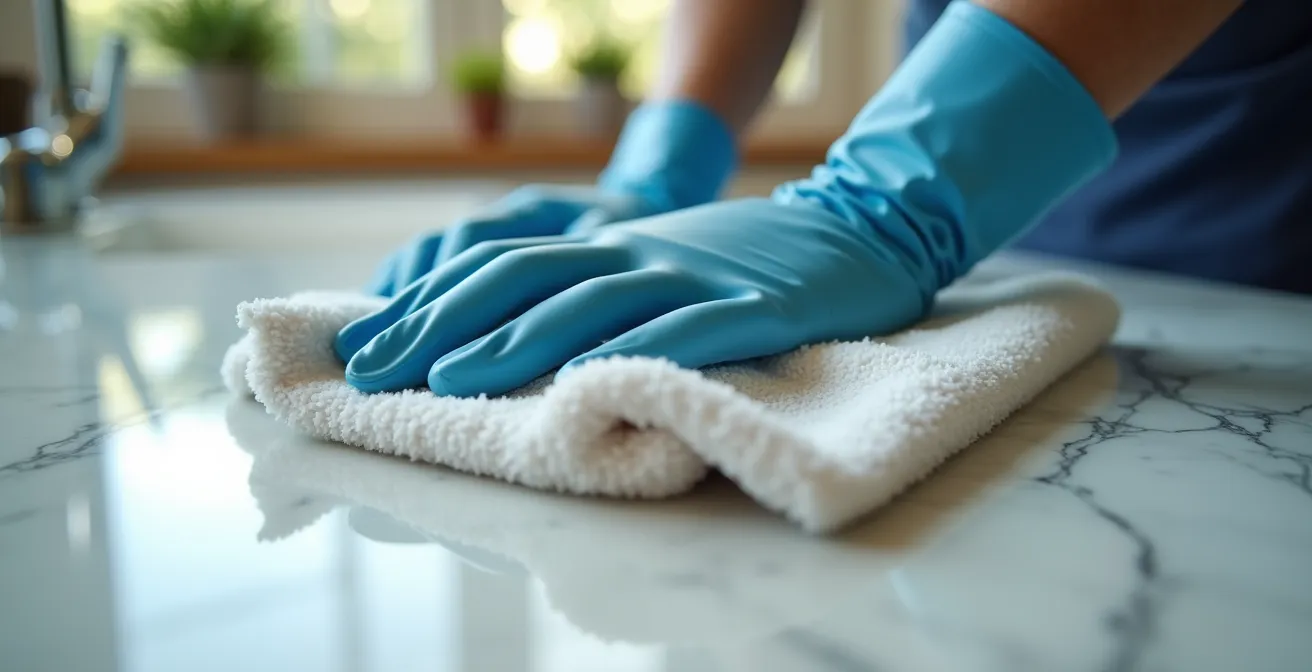
This systematic approach translates directly into asset preservation. Carpets professionally cleaned on a regular schedule last significantly longer than those subjected to amateur efforts or neglect. Grout properly maintained retains its seal and resists staining. Fixtures cleaned with appropriate products maintain their finish rather than degrading prematurely. The long-term financial impact of this preservation easily exceeds the cost of professional services.
The warranty implications underscore the expertise gap starkly. Industry data reveals that over 50% of flooring warranty claims result from improper cleaning and maintenance. Homeowners who believe they’re protecting their investment through diligent DIY care are often unknowingly voiding warranties and accelerating deterioration through well-intentioned but uninformed practices.
| Skill Category | Training Hours Required | Proficiency Level |
|---|---|---|
| Surface Chemistry Knowledge | 40+ hours | Expert |
| Cross-contamination Prevention | 20+ hours | Certified |
| Equipment Operation | 30+ hours | Advanced |
| Product Safety | 15+ hours | Professional |
The number one enemy of the wood floor is the maid
– Flooring Inspector, Professional House Cleaning Manual
This observation, from an industry professional who inspects damaged flooring, highlights the paradox: the people who care most about maintaining their homes often lack the specialized knowledge to do so effectively. Good intentions without proper expertise can produce worse outcomes than benign neglect, particularly on sensitive surfaces that require specific care protocols.
How Delegating Cleaning Reshapes Family Dynamics and Identity
The decision to hire professional cleaners carries psychological weight that extends far beyond the practical. Many people, particularly women, struggle with guilt about “not doing it themselves”—as if managing household cleanliness personally is a moral obligation rather than simply one of many possible approaches to maintaining a home.
This guilt connects directly to identity constructs around being a “good homeowner” or “good parent.” We internalize cultural narratives that equate personal execution of domestic labor with virtue, making outsourcing feel like moral failure rather than strategic resource allocation. Releasing this identity myth requires recognizing that the goal is a well-maintained home, not the performance of maintenance labor itself.
The gender dynamics run particularly deep. Research consistently shows that women perform 75% of household tasks even in dual-earner households, creating an imbalance that professional cleaning can help address. When cleaning is outsourced, it removes a task that has traditionally fallen disproportionately on women, potentially redistributing both the labor and the mental load more equitably.
| Household Type | Women’s Share | Impact of Outsourcing |
|---|---|---|
| Traditional Division | 75-80% | Reduces total burden |
| With Paid Help | 60-65% | Gap narrows but persists |
| During Lockdown | 85-90% | Increased when help lost |
However, the transformation isn’t automatic. Even with professional cleaning, women often continue to carry the mental load of coordinating services, managing schedules, and ensuring standards are met. The shift from execution to management represents progress, but complete equity requires conscious effort to distribute the management responsibilities as well.
For parents, delegating cleaning models important lessons for children about work-life boundaries, delegation skills, and strategic resource management. Rather than teaching that self-sacrifice and doing everything personally demonstrates virtue, it shows children that successful adults make strategic choices about where to invest their time and energy based on their goals and values.
The control paradox emerges clearly in this context: many people resist hiring cleaners because they want control over their home’s cleanliness standards. Yet maintaining personal execution of cleaning often means those standards slip due to time constraints and competing priorities. Delegating the execution while maintaining managerial oversight frequently produces higher and more consistent standards than attempting to do everything yourself. You gain actual control by releasing the illusion that you must personally execute every task.
Creating a connection between home environment and lifestyle quality, professional services enable the kind of environment that supports other life goals. Much like how stylish home decor reflects personal values and aesthetic priorities, a professionally maintained space becomes the foundation for the life you want to live rather than a source of constant low-level stress.
The Behavioral Cascade Effect Professional Cleaning Triggers
The most surprising transformation occurs not in the cleaning itself but in the behavioral changes it catalyzes. A professionally cleaned space creates powerful environmental cues that trigger positive behaviors extending far beyond maintaining cleanliness.
When you walk into a professionally cleaned home, your brain registers the elevated standard and unconsciously adjusts behavior to match. You’re more likely to put things away immediately, wipe down surfaces after use, and maintain the organization between cleanings. The pristine environment sets a behavioral baseline that makes disorder feel more jarring, creating natural motivation to sustain higher standards.
Environmental Cueing and Habit Formation
Research shows that maintaining a professionally cleaned environment creates powerful environmental cues that trigger positive behavioral changes. Individuals report increased productivity, better sleep quality, and improved self-care routines when their living spaces are consistently maintained at higher standards. The cleaned environment acts as a psychological reset that influences behaviors across multiple life domains.
The reset effect transforms cleaning day into an anchor for other positive routines. Many people use their cleaner’s visit as a weekly milestone—decluttering before the cleaners arrive, then using the freshly cleaned space as motivation to tackle other organizational projects. The regular rhythm creates structure that extends beyond cleaning into weekly planning, meal preparation, and other household management tasks.

Social activation represents another significant cascade. When your home is consistently presentable without heroic last-minute cleaning efforts, you’re far more likely to host gatherings, invite friends over spontaneously, and strengthen relationships through your home environment. The psychological barrier to hospitality drops dramatically when you’re not mentally calculating the cleaning required to make your home guest-ready.
The productivity spillover compounds over time in ways that create genuine life transformation. Data indicates that individuals gain approximately 4+ hours weekly leisure time when professional cleaning services are employed. But the impact exceeds simple time reclamation—the mental clarity and reduced stress from outsourcing cleaning creates bandwidth for career advancement, skill development, health improvements, and creative pursuits that would otherwise remain perpetually deferred.
Positive behaviors triggered by professional cleaning
- Increased likelihood to maintain organization between cleanings
- More frequent hosting and social gatherings
- Establishment of morning and evening routines
- Improved focus on health and wellness activities
- Greater investment in home aesthetics and comfort
These cascading effects mirror the broader life improvements that come from strategic resource allocation. Similar to how you might discover luxury living benefits through services that simplify other aspects of life, professional cleaning removes friction from daily existence in ways that enable flourishing across multiple domains.
Key Takeaways
- DIY cleaning’s true cost includes opportunity cost, decision fatigue, and productivity fragmentation far exceeding service fees
- Professional expertise prevents damage from knowledge gaps in surface chemistry, contamination protocols, and systematic cleaning approaches
- Delegating cleaning reshapes household dynamics while requiring conscious effort to redistribute both execution and mental management load
- Professionally maintained spaces trigger behavioral cascades in organization, social connection, and productivity that compound over time
- Calculating personal transformation ROI requires measuring second-order impacts on relationships, career, health, and life satisfaction
Calculating Your Personal Transformation ROI Beyond the Spotless Surface
The decision to hire professional cleaning services ultimately requires a personalized calculation that extends far beyond comparing hourly wages to service fees. Your unique life circumstances, goals, constraints, and values determine where professional cleaning creates disproportionate positive impact.
Building your personal equation means mapping the full spectrum of costs and benefits specific to your situation. Start with opportunity cost—what is your time genuinely worth, either in direct earning potential or in the value of alternative uses? Factor in the mental load reduction, stress decrease, relationship impact, and health benefits that professional cleaning provides for your specific household.
| Factor | DIY Cost | Professional Service Value |
|---|---|---|
| Time (4 hrs/week @ $50/hr opportunity cost) | $800/month | $0 |
| Supplies & Equipment | $50/month | Included |
| Stress & Mental Load | Unmeasured | Eliminated |
| Relationship Impact | Potential conflict | Reduced tension |
| Total Monthly Impact | $850+ | $200-400 |
Identifying your highest-leverage transformation area reveals where professional cleaning creates the most value for you. For someone building a business, the reclaimed time might directly convert to revenue growth. For a parent of young children, the stress reduction and relationship improvement might represent the primary value. For someone managing chronic health conditions, the physical strain reduction and environmental quality might be most significant.
The threshold test determines your personal inflection point—the moment when DIY cleaning shifts from economical to actively harmful to your broader goals. This threshold varies dramatically based on income, family situation, career trajectory, and life stage. Someone early in their career with limited income faces different calculations than an established professional whose time carries high opportunity cost.
Understanding decision fatigue is crucial for maintaining optimal mental health and executive function
– Dr. Shantanu Baghel, Board-certified psychiatrist
Measuring transformation beyond cleanliness requires tracking second-order improvements that manifest over time. Monitor changes in sleep quality, stress levels, relationship satisfaction, and career progression after implementing professional cleaning. These metrics often reveal impacts that far exceed what simple time-savings calculations would predict.
The cost structure itself deserves realistic analysis. Average professional cleaning services range from $149-400 for 2,200 sq ft home depending on service frequency and depth. This investment must be weighed against the total impact on your quality of life, not just compared to the perceived “free” nature of DIY cleaning that carries hidden costs most people never calculate.
Personal ROI assessment checklist
- Calculate your hourly earning potential or value
- Track time spent on cleaning and planning weekly
- Assess stress levels before and after cleaning days
- Monitor relationship satisfaction regarding household tasks
- Evaluate career advancement opportunities with reclaimed time
- Measure health improvements from reduced stress
The transformation professional cleaning enables extends into every corner of life—from the immediate relief of reclaimed weekends to the compounding career benefits of sustained focus, from reduced household conflict to improved health outcomes from lower chronic stress. The visible cleanliness represents merely the most obvious manifestation of a much more profound shift in how you allocate your finite resources of time, energy, and attention toward the life you actually want to build.
Frequently Asked Questions on Professional Cleaning
How does outsourcing cleaning affect gender equality at home?
While professional cleaning reduces total household work, women often continue managing most remaining tasks and carrying the mental load of coordinating services. The shift from execution to management represents progress, but achieving true equity requires conscious effort to distribute both the cleaning coordination and other household management responsibilities between partners.
What happens to family dynamics when cleaning is outsourced?
Partners typically report improved relationship satisfaction and reduced conflict over household responsibilities when professional cleaning is employed. The removal of cleaning as a source of tension creates space for more positive interactions, though the benefits maximize when both partners actively redistribute the freed time and energy toward shared priorities.
How do I know if professional cleaning is worth the cost for my situation?
Calculate your personal opportunity cost by multiplying your hourly value by time spent cleaning weekly, then compare against professional service fees. Factor in intangible benefits like stress reduction, relationship improvement, and career advancement opportunities. The service typically provides positive ROI when your opportunity cost exceeds the service fee and you have clear alternative uses for the reclaimed time.
What’s the difference between professional and DIY cleaning results?
Professional cleaners bring specialized knowledge of surface chemistry, systematic inspection protocols, and damage prevention techniques that most homeowners lack. They address high-impact areas that amateur cleaning routinely misses and use appropriate products and methods that preserve surfaces rather than gradually damaging them through well-intentioned but uninformed practices.